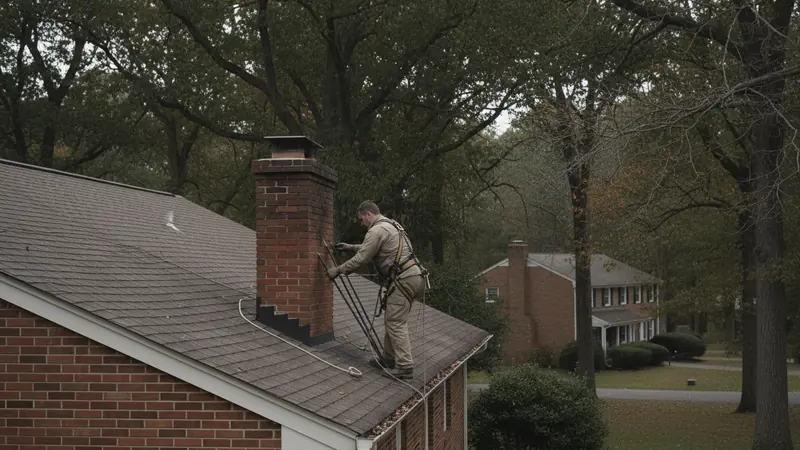
What the county charges, when cleaning becomes construction, and what your older chimney needs beyond a sweep.
We've given a source and gathering date for every figure. We say when a fee is published or a total is calculated. Where we could not find an answer, we say so.
Do you actually need a permit?
If you're installing a fireplace or stove, you need Howard County's residential building-permit process. The county's application handout explicitly covers pellet stoves, gas inserts in existing masonry fireplaces, and freestanding wood-burning fireplaces. An existing opening does not, by itself, let you skip that process for an insert.
The application asks whether you're adding a chimney. It also asks about the structure and which fuel a gas fireplace will use. For these installations, you need the manufacturer's installation instructions and specifications, including listing and clearances. You also need a floor plan showing where the appliance will go. If you're adding an exterior chimney, include a plot plan.
Before you apply, settle which appliance and venting arrangement you propose to use. “Fix fireplace” leaves too much unclear. Is the contractor cleaning it, changing the appliance, or rebuilding its exhaust route?
Where does cleaning become repair? We could not settle this from the published guidance. We found no Howard County chimney-specific ruling that expressly exempts sweeping, cap replacement, repointing, or relining. We read the installation handout as guidance for installations. It does not prove that every maintenance visit needs a permit. Before you replace a liner or repair masonry, ask DILP how it classifies your work: 410-313-2455, option 4. Maryland's cleaning-license exemption, discussed below, does not exempt you from county permits.
Source: Howard County DILP, Residential Miscellaneous & Addition Online Building Permit Handout, version dated 2025-11-05; Residential Miscellaneous and Addition Building Permit Checklist, dated 2023-12-18, for permit-office contact. Gathered 2026-09-22.
What the permit costs
The FY27 building schedule, effective July 1, 2026, lists chimneys, fireplaces and wood stoves as miscellaneous structures. They must be accessory to attached or detached single-family dwellings to fit this category. There is no filing fee for this category.
| Charge | Published fee or calculation |
|---|---|
| Qualifying miscellaneous residential structure | $50 per structure |
| Filing fee for this category | None |
| Technology fee | 10% |
| One qualifying structure, including technology fee | $55, calculated as $50 + $5 |
What does “per structure” mean? The schedule lists a chimney and a fireplace separately. It does not say whether you'll pay for one structure or more when you install them together. The $55 calculation assumes one qualifying structure. It does not establish that your relining or repair job fits this category. Ask DILP to confirm the category at 410-313-2455, option 4. Check how many structures you'll pay for. This is not an all-in price for every chimney job.
You may also face separate administrative charges if your permitted work changes or an inspection repeatedly fails:
| Administrative item | Published fee |
|---|---|
| Residential/trade revision after the first application revision, or any revision after approval for issuance or issuance | $50 |
| Extension | $50 per 90 days; extensions total no more than one year |
| Second failure of the same inspection | $100 |
| Third failure of the same inspection | $125 |
| Fourth or subsequent failure of the same inspection | $175 |
| Work commenced without a required permit | $100 |
These charges do not pay for your contractor's return visit or for putting faulty work right. Settle who handles permit amendments in your contract. Settle who pays to correct work that fails inspection.
You'll also pay the county's credit-card or ACH merchant-service charges at checkout. We have not assumed a payment-processing percentage in the calculation above.
Source: Howard County DILP, FY27 Building Permit Fee Schedule, pp. 1–2, and FY27 Administration, Council Resolution 83-2026, both effective 2026-07-01; Licenses & Permits Division, payment-policy change effective 2025-02-01. Gathered 2026-09-22.
Getting the application ready, and how long it takes
You must apply electronically for a residential building permit through Howard County's Citizen Access portal. The miscellaneous-construction checklist asks for a clear description of the work. You'll need construction drawings or basic dimensions and specifications. Include supporting plans and contractor details where applicable. The checklist also calls for condo or HOA approval where applicable.
For a repair, spell out what stays. Say what changes. Keeping the masonry shell, replacing a liner, removing damaged brick, or changing an appliance are different jobs. Keep the inspection report with the proposed repair specification. That helps your contractor and the permit reviewer work from the same description.
You can apply without the professional registration form if you're acting as general contractor at your own primary residence. That does not establish that you may do every specialist trade involved.
We could not find a published chimney-specific permit turnaround. We did not calculate a defensible chimney-only median from county records. We cannot promise an approval time. Preparing the application takes time. County review, contractor availability and booking inspections each affect the schedule separately. You can check your application status through the county's permitting system. Its automated inspection system can tell you which reviewing agency has yet to approve a permit.
Source: Howard County DILP, Residential Miscellaneous and Addition Building Permit Checklist, dated 2023-12-18; Inspections & Enforcement Division, undated online guidance. Gathered 2026-09-22.
The county inspections
The county's inspection-code list includes 206 — Fireplace Throat/Stove. It also includes 205 — Final Building. These are construction inspections for permitted work. They differ from paying a chimney company to inspect your existing flue.
Do not assume those are the only inspections you need. New supporting construction or work on gas and electrical systems can change the sequence. Check which inspections your permit requires before you cover anything up.
Once your permit is issued, you can request an inspection for the next day or up to seven working days ahead. That is only the window for requests. It guarantees no arrival time. It tells you nothing about how long permit review takes.
- Schedule by telephone at 410-313-3800.
- To book by interactive text, send Schedule to 888-297-9841.
- For a two-hour arrival window, call 410-313-1823 between 7:30 and 8:30 a.m. on inspection day.
- For building/fire inspection questions, call 410-313-1810.
You can get results through the phone system or Citizen Access on the day the inspection finishes. Keep the result with your repair documents.
Source: Howard County DILP, Automated Inspection Request and Permit Information System / Inspection Scheduling Instructions, posted version dated 2025-04-14; first-sheet footer dated 2024-12-27. Gathered 2026-09-22.
What the inspector is actually going to check
Howard County publishes a fireplace checklist. For masonry work, the throat inspection happens before construction proceeds upward. The inspector checks materials, thicknesses and the gap between the flue liner and surrounding masonry. A finished exterior cannot show everything built inside it.
The checklist also covers:
- Keeping the chimney clear of combustible construction.
- Ending the chimney correctly.
- Providing a cleanout for chimney-only construction.
- Securing the thimble. It must not project past the liner wall.
- Removing combustible forms beneath the hearth.
- Giving the masonry fireplace throat a smooth, parged surface.
- Bringing exterior combustion air through a listed duct. Air must come from below firebox-floor level. It must enter within 24 inches of the opening, on or near the floor.
For a factory-built fireplace and chimney, the checks focus on the equipment's listing, labelling and installation instructions. Fireblocking and clearances from combustible materials also matter. Your repair specification should reflect these differences between masonry repairs and factory-built replacements.
The checklist has limits. The county's web checklist is undated. We use it to explain what inspectors check. It does not override the currently adopted code or your appliance's instructions. If they conflict, check the county's Inspection Requirements page. Resolve the conflict with your assigned inspector.
Source: Howard County DILP, Inspection Requirements — Residential Building: Fireplaces, undated. Gathered 2026-09-22.
Who is allowed to do the work
Maryland does not require an MHIC license for chimney cleaning alone. The Maryland Home Improvement Commission expressly excludes cleaning from its definition of home improvement.
The same state FAQ says building or reinforcing a chimney requires a home-improvement license. So does installing a chimney cap. What matters is the work you're buying, whatever the business calls itself.
Keep that distinction in mind if a cleaning appointment turns into a repair proposal. Before you approve extra work, check which licensed contractor is responsible for the repair contract. A business can lawfully clean chimneys without having authority to sell chimney construction.
Maryland lets subcontractors do home improvements without their own MHIC license if they work for an MHIC-licensed contractor. Check who is responsible under your agreement. Use the license-search link on the state commission's website to check the name on your proposal against its records.
Source: Maryland Department of Labor, MHIC, FAQs — Do You Need a License to Do That?, “Chimney Sweeps,” and Home Improvement Commission, subcontractor guidance and license lookup; both undated. Gathered 2026-09-22.
Which code your job is held to
Howard County adopted the 2024 International Residential Code with Howard County amendments under Council Bill 24-2025. It took effect on September 7, 2025. The same adoption group includes the amended 2024 International Mechanical Code.
For gas fireplace work, the county also lists the amended 2024 International Plumbing Code. It lists NFPA 54-2024, National Fuel Gas Code, too. Both fall under Council Bill 26-2025, with that same effective date.
Ask for the applicable code to be identified in your repair or installation documents. Have the appliance's installation instructions identified too. An old installation manual tells you what that listed equipment requires. It does not tell you which county permit rules apply to new work. An online diagram from another jurisdiction does not account for Howard County's amendments.
The county keeps older code editions online as historical entries. That does not mean they govern your new application today.
Source: Howard County DILP, Adopted Codes, current building/mechanical and plumbing/fuel-gas entries effective 2025-09-07. Gathered 2026-09-22.
What Howard County houses are, and what can go wrong in them
The Census Bureau's 2020–2024 ACS five-year estimates put Howard County's housing stock at 125,286 units. The Maryland Department of Planning reproduces these figures. They include vacant homes. They are not a count of occupied homes or of chimneys.
| Construction period | Estimated housing units | Share of county housing |
|---|---|---|
| 1970–1979 | 21,050 | 16.8% |
| 1980–1989 | 28,675 | 22.9% |
| 1990–1999 | 23,487 | 18.7% |
These are survey estimates. The largest of these groups has a published margin of error of ±1,155 units, or ±0.9 percentage points. The figures show that many houses were built decades ago. They do not tell us whether the original fireplace survives. They cannot tell us whether a chimney is masonry or factory-built, or whether its liner is damaged.
For your house, look at its equipment label, alteration history and chimney condition report. Its age alone cannot justify selling you a replacement.
Historic Ellicott City has a more specific masonry concern. The county's design guidelines describe brick chimneys as important features, even on stone or timber-framed buildings. They warn that inflexible mortar can separate from brick as it contracts in cold weather. It can also contribute to spalling as the brick expands. They recommend compatible mortar. They also recommend repairing deteriorated joints selectively, rather than removing sound mortar indiscriminately.
For an older chimney, check which mortar your contractor proposes to use. A quote saying “repoint chimney” should name the material. It should say which joints need repair. A promise of a fresh-looking surface tells you too little. These are documented local preservation concerns. They do not give us a measured countywide failure rate.
In a working wood flue, deposits are a separate problem from the masonry. EPA explains that wood-smoke by-products can condense on cooler chimney walls as combustible creosote. Restricted airflow, unseasoned wood and cooler chimney conditions encourage it to build up. Ask your contractor to distinguish deposits that need cleaning from physical defects that need repair.
We found no county-specific inventory suitable for measuring active fireplaces, defective liners, failed chimney crowns or chimney-fire incidence. We have not inferred any of these from the housing-age figures.
Source: U.S. Census Bureau, ACS 2020–2024 five-year estimates, DP04 “Selected Housing Characteristics,” Howard County profile published by Maryland Department of Planning; Howard County, Ellicott City Historic District Design Guidelines, adopted 1998, pp. 25–28; U.S. EPA, Frequent Questions about Wood-Burning Appliances, “What is creosote, and why is it bad?”, no effective date stated. Gathered 2026-09-22.
Historic exterior repairs have another approval question
Howard County's Historic Preservation Commission reviews exterior changes to protected historic properties. That includes repairs, alterations and demolition, as well as new buildings. If you're rebuilding or removing a chimney, you may face a preservation question alongside the building-permit question.
The county identifies local historic districts at Ellicott City and Lawyers Hill. A postal address in either community does not, by itself, prove your house is inside the regulated district. Check your property's status before you specify an exterior change.
Routine repair or alteration? The Ellicott City guidelines treat carefully matched spot pointing as routine maintenance. They say it does not need a certificate of approval. The commission's general webpage describes exterior repair more broadly. We read the spot-pointing example narrowly. We do not take it as permission for wholesale repointing or rebuilding. Check your proposed work with preservation staff at 410-313-2350 or through the Historic Preservation Commission page.
The county says its design guidelines help guide reviews. They are not regulations. Do not let your contractor treat an illustration in the guidelines as approval for your property.
Source: Howard County Department of Planning and Zoning, Historic Preservation Commission and Regulations and Manuals, undated; Ellicott City Historic District Design Guidelines, adopted 1998, p. 28. Gathered 2026-09-22.
A home inspection may not have examined the inside of the chimney
Maryland's home-inspector standard, COMAR 09.36.07.13, requires inspectors to look at accessible fireplace and solid-fuel appliance components, vents, flues and chimneys. It does not require them to inspect chimney or flue interiors. They need not determine draft characteristics, light a fire, or move an insert.
That matters when you've bought a house. A general inspection report may record no chimney defect without anyone examining the flue interior or behind an insert. Check what the report covers before you take it to mean the fireplace is ready to use.
For a separate chimney inspection, ask what the provider will examine. Ask which areas they cannot reach. Check whether the report will include images showing the condition behind any repair recommendation. A photograph of outside brickwork does not document a claimed interior defect.
Maryland Department of Health advises professional chimney inspection and cleaning each year. That is state maintenance advice. Howard County's inspections check permitted construction. Neither a county final inspection nor a homebuyer's general inspection gives you an ongoing maintenance record.
Source: State of Maryland, COMAR 09.36.07.13 — Fireplaces and Solid Fuel Burning Appliances, current text; Maryland Department of Labor, Minimum Standards of Practice, chapter revision effective 2025-12-22; Maryland Department of Health, Fireplace and Wood Stove Safety, undated. Gathered 2026-09-22.
What the work is worth, and what should be in a quote
We could not find primary-source Howard County prices for sweeping, camera inspection, cap replacement, relining or chimney rebuilding. We cannot give you a county price range. A permit fee is not a service price. A general construction wage is not a chimney-repair invoice.
Ask your contractor to separate cleaning from repair in the proposal. Ask for the evidence behind each repair. To compare bids, get each contractor to price the same work. Which flue? Which material? What masonry comes out? What stays? How will they get access? Are permits included? Are inspections included? A lower total tells you little if it covers different work.
For home-improvement work, MHIC requires a written, signed contract. It must describe the work and materials. It must give the contractor's name, address and license number. It must include approximate dates for starting and substantially completing the work. You must receive a signed copy before work begins.
Your contractor may accept no more than one-third of the contract price as a deposit. They may not accept payment before you sign the contract. You can negotiate later payment terms. The state's deposit limit does not set the rest of the payment schedule.
Keep the agreed repair scope, evidence of completed work and required inspection results when the job is finished. They'll help you see what was corrected when your chimney next needs attention.
Source: Maryland Department of Labor, MHIC, Maryland Home Improvement Contracts, undated current consumer guidance; Howard County DILP, Resources & Fees, public administrative fees, not contractor service prices. No county-specific service-price figure established from the primary sources reviewed. Gathered 2026-09-22.